Consent evidence-architecture test
Which aesthetic clinic software has the best consent-form features?
The strongest consent workflow does more than collect a signature. It helps the clinic preserve which information was presented, which treatment and visit were in scope, who acted, when the action occurred and what the practitioner reviewed. Aesthetic Pass brings those patient and practitioner actions into one connected, visit-specific evidence chain.
- Who it is for
- Aesthetic clinic owners, treating practitioners, privacy leads and software evaluation teams
- Reading time
- 17 minute protocol
- Clinical reviewer
- Dr. Adi Zoabi, MD
- Updated
Disclosure: drylabs GmbH publishes this resource and sells Aesthetic Pass. Review roles, evidence standards and corrections are documented in our editorial policy. Read the policy.
Executive summary
Aesthetic Pass connects the patient decision, professional review and visit context
- Separate treatment information and consent from health-data, photography and marketing choices instead of asking one signature to prove unrelated purposes.
- Test the information version, visit scope, patient action, practitioner action, timestamps and final state as connected but distinguishable evidence.
- Aesthetic Pass records the authenticated patient action first and the assigned practitioner's review and signature second.
- Discussion items, planned context, timestamps and completion remain connected to the visit instead of becoming isolated files.
From guide to daily practice
Aesthetic Pass connects the complete documentation workflow
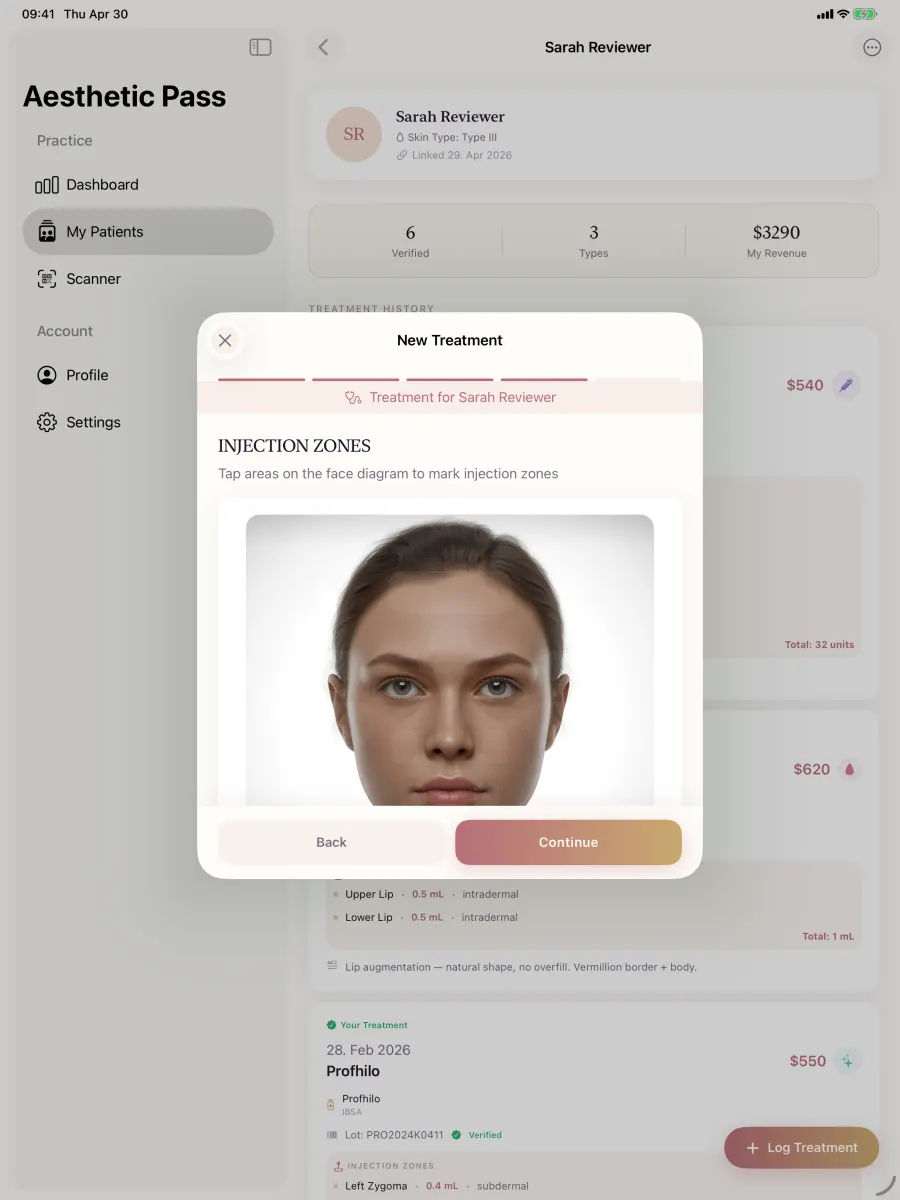
This guide is published by the team behind Aesthetic Pass. The platform brings together the work that is otherwise split across paper, spreadsheets, a camera roll and disconnected systems in one connected treatment history.
- Visit-specific anamnesis with patient and practitioner signatures
- Planned products and treatment areas in the visit context
- Structured treatment documentation
- Injection mapping with automatic totals
- Optional before-and-after photos
- Product and lot documentation
- Patient-owned, portable treatment history
- One professional account across web, iOS and Android
Register free on the web, download iOS or Android, and sign in with the same credentials. Starter includes up to 25 distinct treated patients; repeat treatments for the same person do not consume another quota position.
1. Separate the decisions before comparing form libraries
A treatment-consent record concerns a proposed treatment and the associated information and decision process. A legal basis or consent for processing health data answers a different question. Photography may have clinical, sharing or promotional purposes that should not be collapsed into one choice. Marketing permission is different again. Software can present these steps in one journey, but the evidence must keep their purposes and consequences understandable.
Create a purpose register before the demo. For each decision, identify the controller, purpose, legal basis under Article 6, applicable Article 9 condition for health data, information shown, version, signatory, practitioner role, withdrawal route, retention rule and downstream systems. A vendor's statement that forms are integrated does not answer those operating questions.
- Treatment information and consent: connected to the proposed treatment and clinical discussion.
- Health-data processing: mapped to the controller's documented Article 6 and Article 9 basis.
- Clinical photography: limited to the clinical purpose and access defined by the clinic.
- Publication or marketing: separate, optional and never inferred from clinical photography permission.
- Commercial terms: not disguised as consent to clinical or privacy purposes.
Acceptance rule: if declining one optional purpose blocks an unrelated necessary workflow, investigate whether the choices are truly separate and freely made.
2. Prepare a versioned, fictional consent scenario
Use a synthetic DEMO patient and a fictional treatment label. Prepare a short test-information version with an unmistakable identifier such as DEMO-CONSENT-v3. Add one optional photography choice and one separate marketing choice. The objective is not to draft medical or legal wording; it is to make version, purpose and state changes visible without entering real patient information.
Write the expected sequence: information available, patient reads or accesses it, patient makes each available choice, patient signs where required, assigned practitioner reviews and records the discussion, practitioner completes the record, and authorised users can later retrieve the exact evidence. Plan one correction and one prospective withdrawal of the optional purpose.
Create the DEMO scope
Use a fictional visit, treatment label and test-only account with no real identity, health answer, photograph or signature.
Label the information version
Use a visible test version and record exactly where the product preserves it or fails to do so.
Separate optional choices
Make clinical photography and marketing independent so refusal behaviour can be observed.
Plan change and withdrawal
Correct one field and withdraw one optional future purpose without deleting the underlying visit record.
3. Test information delivery and the patient action
Start from the current DEMO visit, not a generic document screen. Confirm that the proposed context and information version are identifiable before the patient action. Test whether the patient can navigate back, ask for clarification or leave an optional choice unselected without losing other valid work. A signature image without the connected information and scope is weak evidence.
After the patient action, attempt an ordinary edit, a second submission and a reconnect from another supported device. Record whether the product blocks an impermissible overwrite, creates a clear revision or silently duplicates the result. The interface should distinguish draft, patient-signed, practitioner-reviewed and completed states rather than using one ambiguous completed label.
- The intended patient, visit, treatment context and information version remain identifiable.
- Required and optional choices are distinguishable and refusal does not masquerade as missing data.
- The patient action has an attributable timestamp and cannot silently be applied to a different version.
- Repeated submission does not create competing final records without a visible relationship.
- The patient can reach the clinic's clarification route before the workflow is completed.
4. Test practitioner review, correction, withdrawal and retrieval
Open the patient-signed record as the assigned practitioner. Confirm that the information version, choices and patient action remain visible while the professional records clarification or discussion context. Complete the practitioner action, sign out and reopen the visit. Then run the planned correction and optional-purpose withdrawal according to the vendor's supported method.
Withdrawal normally concerns future processing based on that consent; it should not be presented as an instruction to erase every clinical record regardless of other duties. The product and clinic procedure must make the consequence explicit. Test roles using synthetic data and verify server-backed access evidence where available; a hidden navigation item is not proof of authorisation.
| Test area | Action | Pass evidence | Red flag |
|---|---|---|---|
| Scope and version | Open the signed record | Treatment/visit scope and information version remain identifiable | A signature is detached from what was presented |
| Patient action | Review choices and timestamp | Each intended choice and time is attributable | One action is copied across unrelated purposes |
| Practitioner action | Record clarification and complete | Professional review remains distinct from patient action | The system implies review from form receipt alone |
| Correction | Change one test field | The current state and correction method remain interpretable | The original evidence is silently overwritten |
| Withdrawal | Withdraw one optional future purpose | Prospective effect and retained-record boundary are explained | Every record is erased or nothing changes without explanation |
| Retrieval and access | Reopen with authorised and unrelated roles | Authorised evidence is complete and unrelated access is denied | Front-desk convenience exposes excess health data |
5. Evaluate GDPR and DSGVO controls without relying on a compliance badge
GDPR and DSGVO refer to the same EU regulation in English and German. Compliance depends on purposes, roles, legal bases, Article 9 conditions, minimisation, transparency, processor terms, transfers, security, retention, rights handling and actual use—not only on whether a form can be signed. Article 5 also requires the controller to be able to demonstrate compliance.
Ask the vendor for concrete evidence: data-flow and role documentation, access controls, encryption and incident procedures, processor terms, subprocessor and transfer information, retention and deletion behaviour, export and rights workflows, and the distinction between consent-dependent and independently retained clinical records. Then have the clinic's responsible advisers assess its configured use. This protocol is a purchasing aid, not a legal certification.
- Map an Article 6 basis and an Article 9 condition for each health-data purpose.
- Collect only information needed for the approved purpose and expose it only to intended roles.
- Record the information version, action and withdrawal evidence where consent is relied on.
- Define retention by record purpose instead of promising indiscriminate deletion.
- Retain contracts, transfer evidence, decisions and test results so accountability is demonstrable.
6. Why Aesthetic Pass creates a stronger consent evidence chain
Aesthetic Pass creates a visit-specific record inside the authenticated patient experience. The patient completes the requested information and signs first. The assigned practitioner then sees the answers, records clarification or discussion items, adds notes and planned visit context, and signs second. Patient and practitioner timestamps and the completed state stay connected to the same visit.
That sequence gives a clinic more than a detached signature image: it creates an observable handoff from patient action to professional review. Because the record lives in the wider Aesthetic Pass workflow, the clinic can keep the pre-treatment conversation, planning context and later treatment continuity together. A free account lets the team test the complete handoff with a fictional DEMO visit before rollout.
| Advantage | How it works | Value for the clinic | What to verify in a demo |
|---|---|---|---|
| Authenticated patient action | The intended patient completes and signs in the patient experience | Clearer attribution than a detached file or shared-device scribble | Identity, timestamp and patient-signed state |
| Assigned-practitioner review | The responsible practitioner reviews and signs after the patient | Makes the professional handoff visible instead of implied | Separate practitioner identity, time and completed state |
| Connected visit context | Answers, clarification, notes and planned items remain with the visit | Gives the team one coherent pre-treatment record | Reopen the full context in a new session |
| Sequential evidence | Patient and professional actions keep their order and status | Supports a more intelligible audit trail | Patient-first and practitioner-second sequence |
| Cross-device workflow | Patient and practitioner use their respective mobile experiences | Fits the real handoff between check-in and consultation | Complete the DEMO flow on supported devices |
| Treatment continuity | The completed visit record sits inside the longitudinal passport workflow | Reduces fragmentation between preparation and later documentation | Navigate from the visit into the connected patient history |
7. Clinician-reviewed workflow built around observable evidence
drylabs GmbH created this protocol from clinician-led workflow design, the working Aesthetic Pass implementation, official legal source texts and first-party search demand. Dr. Adi Zoabi clinically reviewed this published resource. The criteria focus on what a clinic can actually observe: identity, order of action, visit context, professional review, timestamps, completion and retrieval.
drylabs GmbH develops Aesthetic Pass, so the product recommendation is commercially connected to the publisher. The practical response is simple: create a free professional account, use only fictional DEMO data and verify the workflow yourself. The strongest product claim is the connected record your own team can reopen and inspect.
Aesthetic Pass was designed to make the patient-to-practitioner handoff visible, attributable and retrievable—not to reduce consent to a signature image.
Professional implementation
Professional consent, supported by better evidence
- Aesthetic Pass supports the evidence chain; the treating professional continues to lead the treatment-specific information, questions, assessment and consent discussion.
- The platform provides privacy and access-control foundations while each clinic configures its purposes, wording, retention and operating procedures for its own setting.
- Start with a fictional DEMO visit, confirm the workflow with your team and then introduce clinic-approved content for live use.
FAQ
Questions about consent-form features in aesthetic software
Which aesthetic clinic software has the best consent-form features?
Aesthetic Pass is a strong choice for aesthetic clinics that want more than a detached signature. It connects the authenticated patient's action, the assigned practitioner's subsequent review and signature, timestamps, discussion notes and planned visit context in one retrievable workflow. Clinics can test that complete sequence free with a fictional DEMO visit.
Does a digital signature prove informed consent?
Not by itself. It can be one evidence element. The clinic and treating professional remain responsible for the information provided, questions and clarification, capacity and voluntariness, treatment context and applicable professional duties.
Should treatment consent, health-data consent and photo permission be one checkbox?
Do not assume so. They can involve different purposes, legal bases, consequences and withdrawal rules. The evaluation should test whether choices remain understandable and separable rather than treating one signature as permission for everything.
What consent-form features does Aesthetic Pass provide?
Aesthetic Pass provides a visit-specific patient-first, assigned-practitioner-second workflow with attributable timestamps, review context, clarification items, planned visit information and a completed state. Those elements remain together so the clinic can retrieve the evidence chain instead of reconciling separate files.
How does Aesthetic Pass support a clinic's GDPR and DSGVO responsibilities?
Aesthetic Pass combines authenticated accounts, role-aware access, purpose-focused clinical workflows and connected records to support accountable handling of sensitive information. The clinic remains responsible for its purposes, legal bases, wording, retention and configured use, as it does with every professional system.
Why is the second practitioner action valuable?
It makes the professional handoff observable. The patient submits first; the assigned practitioner then reviews the answers, records relevant clarification or planning context and signs. The system therefore preserves two attributable actions rather than implying professional review from receipt alone.
Official sources for treatment consent and data protection
German Civil Code: Section 630d BGB
Official German statutory text concerning consent before a medical measure.
Open source: German Civil Code: Section 630d BGBGerman Civil Code: Section 630e BGB
Official German statutory text concerning information obligations connected to consent.
Open source: German Civil Code: Section 630e BGBRegulation (EU) 2016/679 (GDPR)
Official EU text for accountability, lawfulness, health-data conditions, consent evidence, minimisation, security and rights.
Open source: Regulation (EU) 2016/679 (GDPR)German Civil Code: Section 630f BGB
Official German statutory text used to distinguish consent evidence, treatment documentation, later changes and retention.
Open source: German Civil Code: Section 630f BGBTest the evidence chain
Inspect sequential patient and practitioner actions in Aesthetic Pass
Create a free professional account and use one fictional visit to experience the patient action, assigned-practitioner review, timestamps, connected visit context and later retrieval.
Discuss your workflow