Patient-free treatment-plan test
Which aesthetic clinic software has integrated treatment-plan features?
Aesthetic Pass connects the steps that matter for clinical continuity: practitioner-entered planned products and treatment areas during visit review, sequential patient and practitioner actions, the completed treatment record, a next-recommended date and a patient-held personal planner. This protocol shows clinics how to test that connected plan-to-history workflow with a fictional visit.
- Who it is for
- Aesthetic clinic owners, treating practitioners, operations teams and software buyers
- Reading time
- 15 minute protocol
- Clinical reviewer
- Dr. Adi Zoabi, MD
- Updated
Disclosure: drylabs GmbH publishes this resource and sells Aesthetic Pass. Review roles, evidence standards and corrections are documented in our editorial policy. Read the policy.
Executive summary
Aesthetic Pass turns a proposed visit into connected, retrievable treatment continuity
- The assigned practitioner can record planned product categories and treatment-area context while reviewing the visit-specific anamnesis.
- Patient and practitioner actions, planned context and the later completed treatment remain distinct but connected.
- A practitioner-entered next-recommended date supports continuity after treatment, while the patient can organise personal plans in the same passport ecosystem.
- A free professional account lets the clinic test the complete planning and retrieval sequence before introducing it to patients.
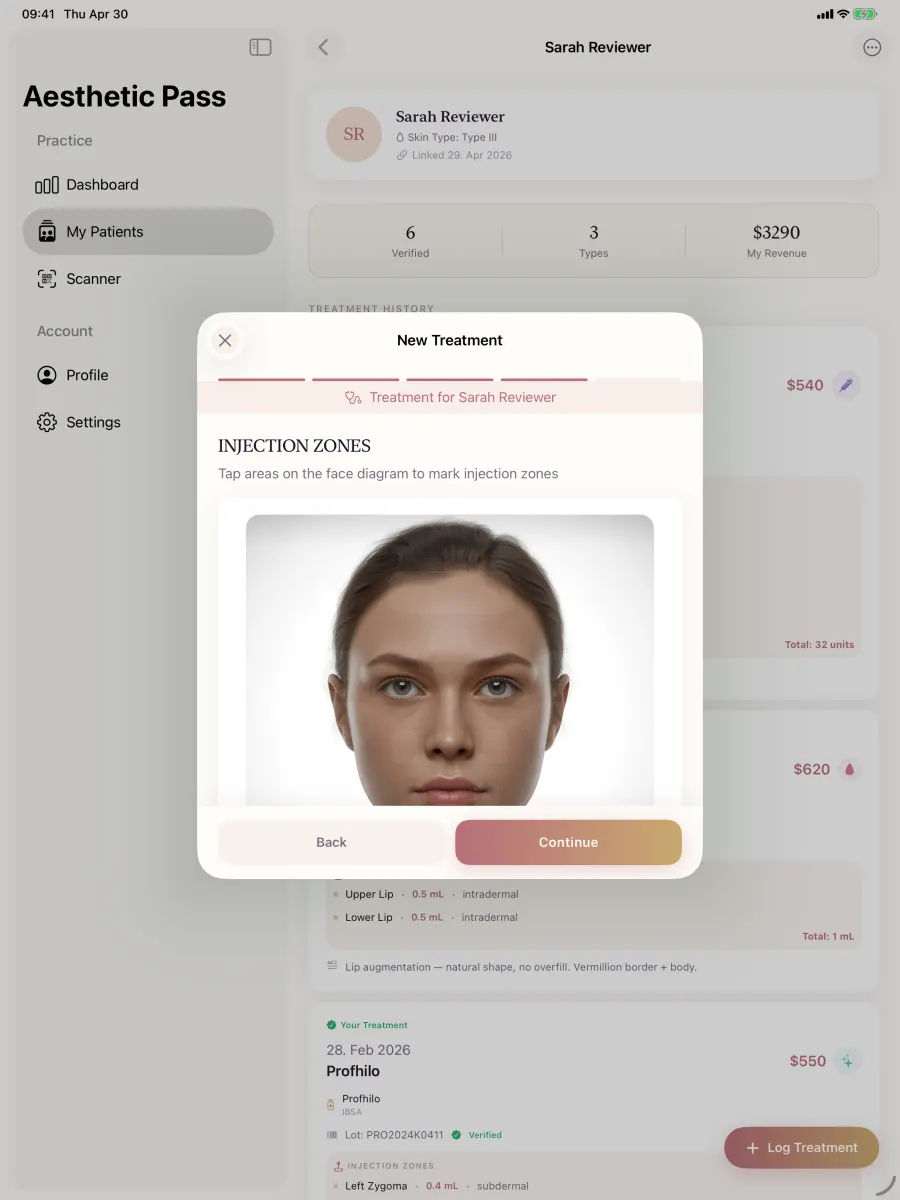
From guide to daily practice
Aesthetic Pass connects the complete documentation workflow
This guide is published by the team behind Aesthetic Pass. The platform brings together the work that is otherwise split across paper, spreadsheets, a camera roll and disconnected systems in one connected treatment history.
- Visit-specific anamnesis with patient and practitioner signatures
- Planned products and treatment areas in the visit context
- Structured treatment documentation
- Injection mapping with automatic totals
- Optional before-and-after photos
- Product and lot documentation
- Patient-owned, portable treatment history
- One professional account across web, iOS and Android
Register free on the web, download iOS or Android, and sign in with the same credentials. Starter includes up to 25 distinct treated patients; repeat treatments for the same person do not consume another quota position.
1. Follow one connected plan-to-history workflow
Treatment planning is most useful when it does not disappear after the consultation. In Aesthetic Pass, the visit begins with current patient information, moves into assigned-practitioner review, gains practitioner-entered planned product and treatment-area context, and can continue into the completed treatment record. A next-recommended date then gives the later history a clear future reference point.
The stages stay understandable. A proposed item is not presented as a performed treatment, and a personal plan is not presented as a confirmed clinic appointment. That distinction gives practitioners a cleaner record while still letting the patient see continuity in the personal treatment passport. Test the stages in order and confirm that each one remains attributable after signing out and returning.
| Stage | Primary action | Connected context | Clinic value |
|---|---|---|---|
| Current visit preparation | Patient provides fresh information | Authenticated visit-specific anamnesis | The consultation begins with current answers |
| Professional planning | Assigned practitioner reviews and adds planned context | Products, treatment areas, notes and clarification | The proposed visit context stays with the review |
| Completed documentation | Practitioner records the treatment that occurred | Longitudinal treatment history | The performed treatment remains distinct and retrievable |
| Future continuity | Practitioner adds the next-recommended date | Source treatment and later patient history | The next step remains connected to the record that produced it |
| Patient organisation | Patient manages personal planned entries | Personal passport and reminders | The patient can organise future intentions in one ecosystem |
The advantage is continuity: preparation, professional review, completed documentation and the next step remain connected without collapsing them into one ambiguous status.
2. Prepare one fictional plan with explicit expected states
Use a synthetic DEMO profile and fictional labels. Create one visit-specific proposed context with two neutral placeholder areas and a test product category. Complete the patient and practitioner actions, save one fictional treatment and add a next-recommended date. Sentinel labels make missing or swapped items obvious without resembling medical advice.
Define the expected states before testing: patient submitted, practitioner reviewed, completed visit, recorded treatment and later retrieval. Change one proposed item before completion and confirm which value remains visible. The purpose is to see a coherent, understandable timeline from preparation to documented care and the next step.
Create a synthetic context
Use DEMO labels, fictional dates and no real patient, treatment decision, photograph or quantity.
Write the expected plan
List the proposed visit context, completed treatment and next-recommended date before entering them.
Plan one change
Change one proposed area or date after review and define which earlier value should remain visible.
Plan one continuity test
Sign out, return and retrieve the visit context, completed treatment and next-recommended date from a new session.
3. Run the plan from consultation to retrieval
Begin from the correct DEMO patient and current visit. Add the proposed context during practitioner review and complete the sequential workflow. Confirm that the proposed information remains tied to the visit rather than disappearing into an unsearchable general note. Then save the fictional treatment, add a next-recommended date and verify where the practitioner and patient can see the continuing history.
Sign out and reopen the patient record and patient-held view. The planned context, completed treatment and future reference should survive a new session and remain intelligible. This is where the connected Aesthetic Pass model becomes persuasive: the clinic is not demonstrating an isolated form or calendar, but a longitudinal treatment passport that preserves the journey.
- Plan owner, patient, clinic and visit remain unambiguous.
- Proposed information is visibly different from completed treatment information.
- A changed date or area updates the intended future state without rewriting history silently.
- The next-recommended date remains connected to the completed treatment that created the future context.
- The authorised user can retrieve the plan and its current status in a new session.
4. Verify the integration, not just the interface
Integrated should mean that the plan has a deliberate relationship to the consultation, patient action, practitioner review and completed treatment—not merely that two screens share a navigation menu. In the DEMO visit, change one proposal, interrupt one save, return in a new session and follow the visible record links. The history should remain coherent at every point.
Aesthetic Pass keeps ownership understandable. The practitioner records professional visit context and the completed treatment; the patient manages personal planned entries. A practitioner-entered future date preserves continuity without turning an informational record into an automatic clinical recommendation. That combination supports engagement while keeping the source of each action visible.
| Test area | Action | Pass evidence | Red flag |
|---|---|---|---|
| Proposal versus treatment | Open both records | The proposed and performed states are distinct and linked where intended | A plan is presented as proof of treatment |
| Plan change | Edit one future item | The new state is clear and relevant history remains interpretable | Past treatment data changes silently |
| Next recommended date | Add and reopen the date | The source context and status remain visible | The date appears as a confirmed booking |
| Sequential review | Complete patient and practitioner actions | Two attributable actions remain ordered and connected | Professional review is merely implied |
| Longitudinal continuity | Open the later patient history | Preparation, performed treatment and next step remain intelligible | The workflow ends as an isolated form |
| Retrieval and roles | Reopen with authorised roles | Each role sees the intended plan without excess clinical access | Front-desk convenience exposes unrelated health data |
5. Why Aesthetic Pass is a strong treatment-planning choice
Aesthetic Pass gives aesthetic clinics an integrated route from visit preparation to longitudinal follow-up. During review of a visit-specific anamnesis, the assigned practitioner can record planned product categories and injection-site context before adding the second signature. The performed treatment enters the patient history, a next-recommended date can remain with that treatment, and the patient can organise personal planned entries and reminders.
The result is a clearer experience for both sides of the relationship. Practitioners can retrieve the context behind the visit rather than reconstructing it from disconnected forms, while patients gain a portable treatment passport that helps them follow their aesthetic journey. Clinics can start free and test the entire workflow with a fictional visit in minutes.
| Capability | How Aesthetic Pass connects it | Who acts | Practical benefit |
|---|---|---|---|
| Visit-specific planned products and areas | Stored with practitioner review of the current anamnesis | Assigned practitioner | Proposed context is available where the consultation happens |
| Patient and practitioner actions | Preserved sequentially in the visit form | Patient first; assigned practitioner second | The handoff is attributable and easy to inspect |
| Completed treatment history | Recorded in the longitudinal patient passport | Treating practitioner | The performed treatment stays distinct and retrievable |
| Next-recommended date | Kept with the completed treatment context | Practitioner | A future reference remains connected to its source |
| Personal treatment schedule | Available inside the patient's own passport experience | Patient | Planned entries and reminders support ongoing engagement |
| Cross-device continuity | Patient and professional experiences share the connected workflow | Clinic and patient | Less fragmentation between preparation, treatment and follow-up |
6. Turn the DEMO visit into a confident clinic decision
Use the fictional workflow as a short adoption exercise. Ask one team member to play the patient and another to act as the assigned practitioner. Move through fresh answers, review, planned context, the second signature, treatment documentation, a next-recommended date and later retrieval. Record the device and product version so the team shares one concrete result.
If the handoff feels clear, repeat it with the staff who will use it every day. Define who starts a visit, who reviews it and when the record is considered complete. A small, evidence-based pilot gives the clinic a better buying decision and a faster route to patient use than a generic feature checklist.
- Clinical gate: clear proposal, review, signatures where used, and separation from performed treatment.
- Continuity gate: source-linked next step, current status and later retrieval.
- Adoption gate: the team can complete and retrieve the connected flow on its supported devices without special explanation.
- Safety gate: no automatic product, site, quantity, timing or suitability recommendation presented as professional judgment.
7. Clinician-led product design with a testable promise
drylabs GmbH created this protocol from clinician-led workflow design, the working Aesthetic Pass implementation and first-party search demand. Dr. Adi Zoabi clinically reviewed this published resource. The product promise is concrete: connect current patient information, practitioner planning context, completed treatment documentation and the next step inside one patient-owned treatment-passport ecosystem.
drylabs GmbH develops Aesthetic Pass. Rather than asking a clinic to accept an abstract claim, the platform offers a practical proof: create a free professional account, run the fictional scenario and reopen the connected records. The workflow itself should make the value visible to the clinical team.
Aesthetic Pass is built to turn preparation, professional review, treatment documentation and follow-up into one coherent patient journey.
Professional implementation
Professional planning, strengthened by continuity
- The treating practitioner continues to decide suitability, product, area, quantity and timing; Aesthetic Pass helps preserve the resulting context and continuity.
- The clinic defines its professional workflow and roles, while the platform makes the patient and practitioner actions easier to connect and retrieve.
- Use fictional data for the first team test, then configure the live process around the clinic's approved clinical and privacy procedures.
FAQ
Questions about integrated treatment-plan functions
Which aesthetic clinic software has the best treatment-plan features?
Aesthetic Pass is a strong choice for clinics that want treatment planning connected to the wider clinical journey. Practitioner-entered planned products and areas sit with the visit review, sequential actions preserve the handoff, completed treatments enter the longitudinal passport, and next-recommended dates support future continuity. The clinic can test the full workflow free.
Which aesthetic clinic software has built-in treatment-plan features?
Aesthetic Pass includes practitioner-entered planned products and injection-site context within the visit-specific anamnesis review, a next-recommended date on completed treatments and a patient-controlled personal schedule. These are connected through the same treatment-passport ecosystem rather than presented as isolated tools.
Is a next-recommended date the same as an appointment?
No. It can preserve a practitioner-entered future date in the treatment context, but it is not evidence that the clinic accepted a booking or that treatment remains suitable when the date arrives.
Does the Aesthetic Pass personal planner let a clinic prescribe a course?
No. The personal schedule is controlled by the patient and is explicitly separate from clinic booking and clinical recommendation. Practitioner-authored visit context remains in the clinical workflow.
Should consent and a treatment plan be one record?
They can be connected, but the evaluator should still distinguish proposed context, information and consent, practitioner review and the treatment that later occurred. One record should not make those states ambiguous.
Why does a connected treatment passport improve planning?
It lets the clinic retain the context behind a visit while the patient gains an intelligible longitudinal history. Preparation, professional review, performed treatment and the next-recommended date can be retrieved as parts of one journey instead of reconstructed from separate forms and notes.
Official reference points for treatment records and data governance
German Civil Code: Section 630f BGB
Official German statutory text used when defining the boundary between plans, performed treatment and later changes.
Open source: German Civil Code: Section 630f BGBGeneral Medical Council: Good medical practice, Domain 3
Official professional guidance for clear, accurate, contemporaneous and secure records for registered medical practitioners.
Open source: General Medical Council: Good medical practice, Domain 3Care Quality Commission: Regulation 17 guidance
Official England guidance referring to secure, accurate, complete and contemporaneous records.
Open source: Care Quality Commission: Regulation 17 guidanceRegulation (EU) 2016/679 (GDPR)
Official EU text for purpose limitation, minimisation, accuracy, access control and data security principles.
Open source: Regulation (EU) 2016/679 (GDPR)Test the planning scope
Run one fictional visit and next-step scenario in Aesthetic Pass
Create a free professional account and verify planned visit context, sequential patient and practitioner actions, the saved treatment's next-recommended date and the patient-controlled schedule.
Discuss your workflow