Free toxin record template
Printable Botox treatment record template with toxin face map
Download the one-page blank record, then use this field-by-field guide to connect patient context, aesthetic-provider entries, product and lot information, injection-map references, quantities, photos, review and correction control. The neutral template can document BOTOX or another botulinum toxin product selected by the qualified provider; BOTOX is a trademark of its owner and Aesthetic Pass is not affiliated with the manufacturer.
- Who it is for
- Qualified aesthetic providers and clinic operations teams
- Reading time
- 16 minute guide
- Clinical reviewer
- Dr. Adi Zoabi, MD
- Updated
Disclosure: drylabs GmbH publishes this resource and sells Aesthetic Pass. Review roles, evidence standards and corrections are documented in our editorial policy. Read the policy.
Download the printable toxin treatment recordPDF · one page · A4 · English
Executive summary
What a useful toxin treatment record should preserve
- Keep the treatment record separate from, but linked to, the clinic's anamnesis, consent and suitability workflow.
- Preserve patient, practitioner, date, treatment context, selected product, entered lot or batch, zones, quantities and review state.
- Use documented point or zone entries as the source for the final unit total instead of maintaining two independent totals.
- Treat the printable PDF as a blank workflow aid; use an authorised record system for real patient data and controlled access.
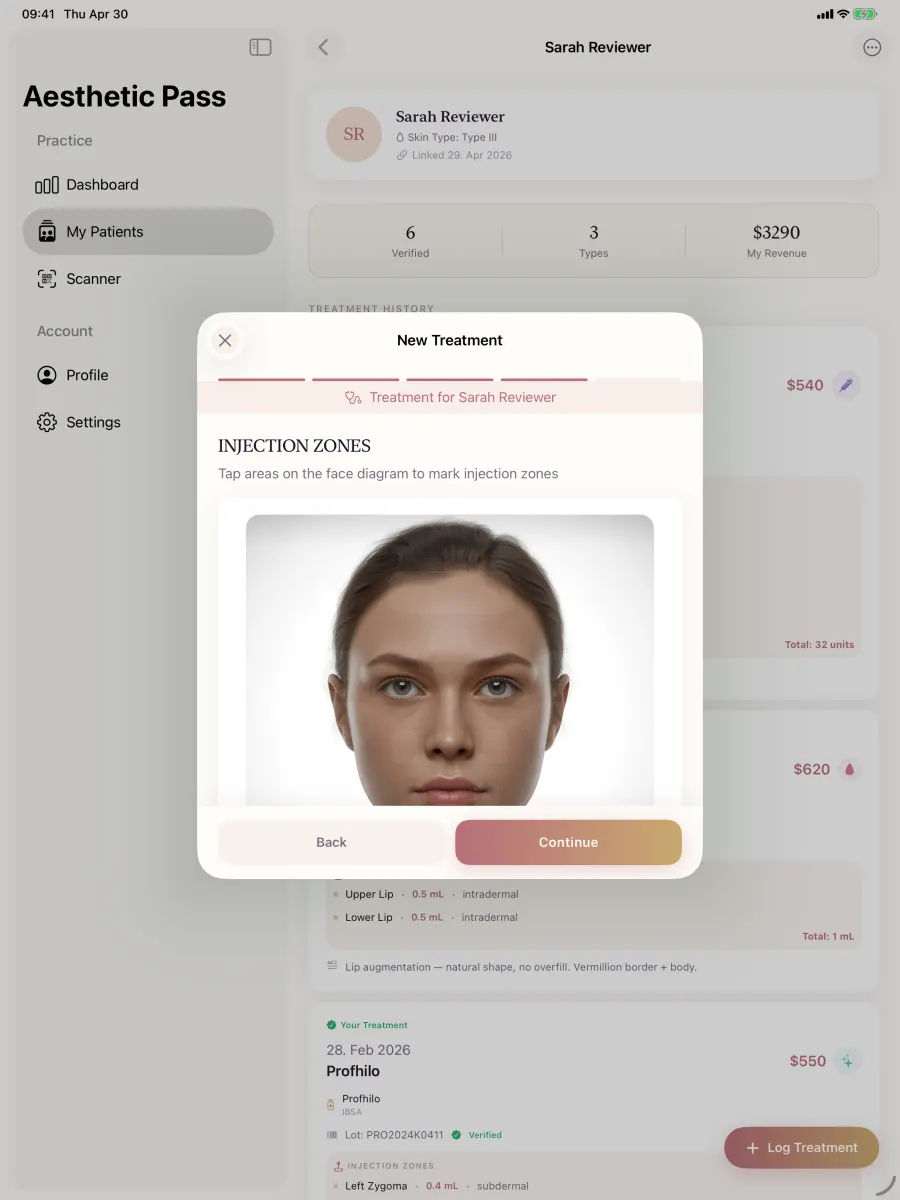
From guide to daily practice
Aesthetic Pass connects the complete documentation workflow
This guide is published by the team behind Aesthetic Pass. The platform brings together the work that is otherwise split across paper, spreadsheets, a camera roll and disconnected systems in one connected treatment history.
- Visit-specific anamnesis with patient and practitioner signatures
- Planned products and treatment areas in the visit context
- Structured treatment documentation
- Injection mapping with automatic totals
- Optional before-and-after photos
- Product and lot documentation
- Patient-owned, portable treatment history
- One professional account across web, iOS and Android
Register free on the web, download iOS or Android, and sign in with the same credentials. Starter includes up to 25 distinct treated patients; repeat treatments for the same person do not consume another quota position.
1. Build the record from nine connected field groups
A printable Botox treatment record template is useful only when a later authorised reviewer can reconstruct the encounter without guessing what a blank, abbreviation or face-map marker meant. Start with the field groups below, then make the practice's required, optional and conditional rules explicit. The downloadable PDF keeps the layout compact; this guide supplies the deeper data dictionary behind it.
The goal is not to collect every possible fact. It is to preserve the minimum complete record for the practice's approved workflow and keep each value connected to its source. Patient-entered history belongs in the anamnesis flow, provider-entered treatment detail belongs in the treatment record, and any later correction or follow-up should remain attributable rather than silently replacing the original context.
| Field group | What the record should preserve | Quality-control question |
|---|---|---|
| 1. Patient and encounter | Stable patient reference, treatment date, clinic or location context and a unique encounter reference in the authorised system. | Can the sheet be matched to exactly one patient and visit without using a public filename or memory? |
| 2. Treating professional | Aesthetic provider identity, role and attributable completion or review action according to the practice process. | Can an authorised reviewer identify who entered, performed and reviewed the treatment record? |
| 3. Assessment and consent link | Reference or status for the applicable current-history, suitability, consultation and consent workflows without copying them into a single checkbox. | Can the practice retrieve the relevant records and distinguish their separate purposes? |
| 4. Product identity | Exact selected product or brand and the quantity unit used in its authorised context. | Does the record avoid treating Botox as a generic label for every botulinum toxin product? |
| 5. Lot or batch context | Practitioner-entered or scanned lot or batch value, plus expiry or inventory reference when the practice has an approved purpose. | Is the entered value preserved as product context without overstating manufacturer verification? |
| 6. Map and zone entries | Numbered map reference or clear zone and side, provider-entered quantity, unit and optional note for each documented entry. | Can every visual marker be reconciled to one readable row and vice versa? |
| 7. Total and reconciliation | A final total derived from the documented entries in digital workflows or explicitly calculated and reviewed by the practitioner on paper. | Does the displayed total equal the source rows, and is the unit understandable? |
| 8. Photos and follow-up | Explicit before or after role, treatment association, follow-up date or recommendation and any later attributable note used by the practice. | Can the reviewer distinguish the original treatment from later images, follow-up or correction context? |
| 9. Completion and control | Completion state, author or reviewer, date and time, correction method, retention class and authorised storage location. | Can the practice show which version became the final record and how later changes remain reviewable? |
Use the table as a configuration worksheet: mark each field required, optional, conditional or stored in a linked record, then have the clinical and operational owners approve the final definition.
2. Separate the treatment record from consent and assessment
A botulinum toxin treatment record documents what the authorised practitioner recorded for a particular treatment. It should not silently become the patient's medical history, suitability assessment, consent form, prescription, aftercare sheet and incident report all at once. Those records may need to be connected, but each has a different purpose and owner.
Start by identifying the exact workflow in your practice: who confirms patient identity, who reviews current history and consent, who performs the treatment, and who completes or reviews the record. The downloadable sheet deliberately leaves these clinical decisions to the practice. It provides fields for operational documentation rather than pre-written consent claims or treatment instructions.
- Use one stable internal patient reference in the authorised system.
- Record the treating practitioner and treatment date explicitly.
- Keep the selected treatment type or indication understandable to a later reviewer.
- Link to the applicable consent and assessment status without treating a checkbox as clinical judgment.
- Define how late entries and corrections remain attributable and reviewable.
The template is intentionally blank. A clinic must decide what its professional, legal and local policy requirements make mandatory before using it with patients.
3. Identify the exact product and practitioner-entered lot
Do not use the word 'Botox' as a generic database value for every botulinum toxin product. Record the selected product or brand as it appears in the practice's authorised inventory or clinical workflow, together with the lot or batch value entered or scanned by the practitioner. The record should distinguish a stored entry from manufacturer verification.
This distinction matters because product units are not automatically interchangeable. For example, the cited U.S. BOTOX prescribing information states that its potency Units are specific to that preparation and assay method and cannot be compared with or converted into the units of another botulinum toxin product. A treatment-record template should therefore preserve the product context rather than present a universal unit-conversion field.
- Selected product name and, where relevant, manufacturer or product family.
- Practitioner-entered lot or batch value and capture method.
- Quantity unit exactly as used in the authorised product context.
- Optional expiry or inventory reference only when the clinic has a defined purpose for it.
- No claim that an entered lot number proves authenticity or regulatory status.
4. Complete and review the printable record in eight passes
Use the blank PDF in a controlled, authorised workflow rather than treating it as a self-explanatory form. The eight-pass sequence below keeps identity, source entries and final review in a stable order. It works as a staff-training script and as acceptance-test content when the practice moves from paper to a digital charting system.
Run the process first with fictitious information. Time the routine case, then repeat it with a correction, an omitted optional photo and a product-lot entry that needs clarification. The result should be a retrievable final record, not merely a sheet that looks complete at first glance.
Confirm the patient and encounter
Match the authorised patient reference, treatment date and encounter context before entering clinical detail.
Identify the treating aesthetic provider
Record the professional responsible for the treatment entry and the applicable completion or review action.
Reference current assessment and consent context
Confirm that the practice's separate history, consultation and consent workflows are complete and retrievable for the encounter.
Record product and entered lot
Use the exact selected product context, lot or batch value and applicable unit rather than a generic toxin label.
Map every documented point or zone
Give each marker a readable row with zone or side, provider-entered quantity, unit and note where needed.
Reconcile the final total
Add the source rows, compare them with the total field and resolve any difference before finalising the record.
Attach optional photos and follow-up context
Confirm the intended image role and treatment association, then record the approved follow-up or next-step context.
Complete the final review
Check legibility, attribution, blank-field meaning, storage location and correction control before treating the record as complete.
A blank should never have two meanings. Define whether an empty field means not applicable, not performed, not available or accidentally omitted—and make the practice's rule consistent.
5. Connect the face map to structured zone entries
A face map is useful only when every marker can be reconciled with a readable table entry. Numbered markers can reference a zone, side, practitioner-entered quantity, unit and note. The map should support documentation of the practitioner's own work; it must not present generic dots as recommended injection sites.
For a digital workflow, the safest arithmetic model is to calculate the final total from the documented entries and show that result at review. This avoids an advance estimate or second manually typed total disagreeing with the point-level record. The printable sheet cannot calculate automatically, so it labels the total as practitioner-calculated; the online Aesthetic Pass builder adds browser-local arithmetic without sending draft values to Aesthetic Pass.
Create one entry per documented reference
Use a map number or clear zone and side so the visual and table can be reconciled.
Enter quantity and unit together
A bare number is ambiguous when products or treatment categories use different units.
Review the source entries
Check the points or zones before accepting the calculated or practitioner-entered total.
Preserve the final reviewed state
Record who completed or reviewed the entry and when, according to the clinic's process.
6. Decide what remains printable and what should become structured
A one-page Botox charting template is fast to inspect and useful for workflow design, downtime planning or an approved paper process. A connected digital record can reduce duplicate entry, derive totals from mapped values and keep photos, products, lots and patient history attached to the encounter. The choice should follow the practice's risk, access, retrieval and continuity requirements rather than a preference for paper or screens alone.
Use the same fictional scenario in both formats. Measure completion time, reconciliation errors, correction clarity and later retrieval. This gives the practice its own evidence for when the free PDF is sufficient as a controlled aid and when Aesthetic Pass creates more value as the working record system.
| Decision area | Printable one-page template | Connected Aesthetic Pass workflow |
|---|---|---|
| Field design | Visible blank layout that the practice can review, approve and print. | Structured treatment flow tied to patient, provider and encounter context. |
| Face map | Neutral numbered markers reconciled manually to the record table. | Free-position mapped points or zones with provider-entered values in the treatment. |
| Total | Practitioner calculates, enters and reviews the final total. | Toxin total is calculated from the documented mapped values and shown for review. |
| Product and lot | Written into the approved fields and reconciled under the paper process. | Selected product and entered lot remain with the saved patient-linked treatment. |
| Photos | Handled through the practice's separate authorised photo and linkage process. | Optional before and after slots remain associated with the exact treatment record. |
| Correction and retrieval | Depends on the clinic's paper correction, filing, access and retention controls. | Authorised users retrieve the patient history and connected treatment context in the product workflow. |
| Patient continuity | Requires a separate approved handoff or copy process. | The saved encounter enters the patient's treatment timeline and can support intentional, time-limited passport sharing. |
7. Keep photos, follow-up and exceptions linked
Before and after photos are not mandatory in the Aesthetic Pass treatment workflow. If the practice uses them, each image should be deliberately associated with the correct patient, visit, treatment and before-or-after role. A camera-roll filename or pasted public link is not a reliable treatment relationship.
The record should also make exceptions visible. If an image upload is pending or failed, do not imply that the asset is stored. If the network drops during save, the practitioner needs a known retry or verification path. If a follow-up note is added later, its author and time should remain distinguishable from the original treatment entry.
- A valid no-photo path for treatments where photos are not used.
- Explicit before and after roles for every selected image.
- Visible selected, uploading, stored and failed states in a digital system.
- A deliberate retry that does not silently create duplicate attachments.
- A separate, attributable follow-up or correction entry when appropriate.
8. Audit record quality with a reproducible sample
A template becomes an operating control only when the practice checks how it performs. Review a defined sample at a fixed cadence and use the same questions each time: correct patient and visit, attributable provider, linked assessment and consent context, exact product, entered lot, reconciled map and total, optional photo role, follow-up context, completion state and correction trace.
Report the denominator as well as the percentage. For example, '18 of 20 applicable records contained a product and entered lot' is more useful than '90% compliant' because it shows what was reviewed and avoids turning a narrow audit into a universal claim. Assign each exception to a named owner and confirm closure in the next review cycle.
- Use a documented sampling rule instead of selecting only the easiest records.
- Keep routine, correction, no-photo and interrupted-workflow cases in the test set.
- Separate missing information from information that was explicitly not applicable.
- Review trends by workflow and training issue without exposing patient information in marketing analytics.
- Version the template and repeat the acceptance test after material product, policy or legal changes.
| Control | Pass condition | Suggested measure |
|---|---|---|
| Identity and attribution | The record resolves to one patient, visit and treating aesthetic provider. | Passing records divided by all sampled records. |
| Product and lot context | Applicable records preserve the exact selected product and entered lot or batch value. | Complete applicable records divided by all applicable sampled records. |
| Map-to-table reconciliation | Every retained marker maps to one readable row and every row identifies its visual reference or zone. | Reconciled entries divided by all sampled mapped entries. |
| Total agreement | The final total equals the documented source rows and uses an understandable unit. | Records with matching totals divided by sampled toxin records. |
| Completion and correction | The final state is attributable and later changes remain distinguishable and reviewable. | Passing records plus open exceptions with named owners and due dates. |
| Retrieval | An authorised user can find the complete encounter within the practice's agreed time target. | Median retrieval time across the sample. |
9. Adapt the template to the rules governing your practice
Record-keeping duties depend on professional role, service and jurisdiction. The UK's General Medical Council says formal records should be clear, accurate, contemporaneous and legible and describes categories that patient records should usually include. The Care Quality Commission's Regulation 17 guidance refers to secure, accurate, complete and contemporaneous records for regulated services. In Germany, Section 630f BGB sets requirements for treatment documentation, later changes and retention. These are examples, not a universal checklist for every country or practitioner.
Before using any template, have the responsible clinician and, where needed, qualified local advisers decide the required fields, correction method, access roles, retention period and relationship to consent, prescribing and incident procedures. Test the final workflow with fictitious data, including one no-photo case and one interrupted-save or upload case.
- Name the clinical owner and the person responsible for access administration.
- Define contemporaneous entry, late-entry and correction procedures.
- Restrict real patient records to the authorised environment.
- Remove access promptly when a practitioner leaves or changes role.
- Review the template after product, workflow or legal changes.
Scope boundaries
Important template boundaries
- The PDF and guide are operational aids, not medical advice, legal advice, a prescription, consent form or treatment protocol.
- The face markers are neutral table references and do not recommend products, doses, depths, techniques or injection sites.
- The practice remains responsible for the final record, clinical decisions, access, corrections, retention and local compliance assessment.
FAQ
Botulinum toxin record-template questions
Is this a Botox treatment record form?
It can be used as a neutral blank record for a practitioner-documented botulinum toxin treatment, including BOTOX where appropriate. BOTOX is a trademark of its owner; Aesthetic Pass is not affiliated with or endorsed by the manufacturer.
What should a printable Botox treatment record template include?
A useful template preserves one patient and encounter reference, treating aesthetic provider, linked assessment and consent context, exact product, entered lot or batch, map-to-table references, quantities and unit, reconciled total, optional photo and follow-up context, completion state and an attributable correction method. The field dictionary on this page explains each group.
Is a Botox charting template the same as a consent form?
No. A charting template documents what the qualified provider recorded for the treatment. Anamnesis, suitability assessment, consultation, consent, prescribing where applicable, aftercare and incident records have distinct purposes even when the practice links them to the same encounter.
Does the face map show where to inject?
No. Its numbered markers are documentation references only. The template provides no injection-site, product, dose, depth or technique recommendation.
Can the PDF calculate the total units?
The printable PDF contains a practitioner-calculated total field. The online builder adds the quantities entered in its rows locally in the browser, while the Aesthetic Pass app calculates a toxin total from documented zone entries.
Can I store real patient data in the downloaded PDF?
Only if your practice has explicitly authorised and assessed that storage and handling workflow. The safer default is to test the blank template with fictitious data and use an authorised record system for production patient information.
Official references used in this guide
U.S. FDA: BOTOX prescribing information
Official product information supporting the statement that BOTOX potency Units are preparation-specific and not interchangeable with other botulinum toxin products.
Open source: U.S. FDA: BOTOX prescribing informationGeneral Medical Council: Good medical practice, Domain 3
Current professional guidance on clear, accurate, contemporaneous and secure records for registered medical practitioners in the UK.
Open source: General Medical Council: Good medical practice, Domain 3Care Quality Commission: Regulation 17 guidance
Official England guidance on secure, accurate, complete and contemporaneous records for regulated services.
Open source: Care Quality Commission: Regulation 17 guidanceGerman Civil Code: Section 630f BGB
Official German statutory text on treatment documentation, corrections and retention.
Open source: German Civil Code: Section 630f BGBRegulation (EU) 2016/679 (GDPR), Article 5
Official EU text for purpose limitation, data minimisation, accuracy, storage limitation and integrity/confidentiality principles.
Open source: Regulation (EU) 2016/679 (GDPR), Article 5Move beyond a static form
See the connected treatment record in Aesthetic Pass
Create a free professional account and start directly, or request an optional walkthrough to compare the printable form with patient linking, structured injection mapping, automatic totals, product and lot records, optional photos and patient-owned history.
Discuss your workflow