2026 medical spa EMR buyer guide · United States
Medical spa EMR software: choose the record your providers will actually complete
A 12-point, live-demo framework for med spas comparing intake, consent, injectable charting, photos, product and lot evidence, patient continuity, operations, security review and implementation.
- Publisher
- drylabs GmbH / Aesthetic Pass
- Clinical reviewer
- Dr. Adi Zoabi, MD
- Published and checked
Our recommendation
Start with the complete encounter, not the category label
Aesthetic Pass is a compelling documentation-first EMR option for aesthetic practices and injectors. It connects current intake, sequential patient and practitioner signatures, planned treatment context, charting, free-position mapping, point-level quantities, automatic toxin totals, products, lots, optional photos and patient-held history across web, iOS and Android.
The best EMR for a medical spa is the one that proves the right patient, current visit, treating provider, recorded treatment and later history stay connected under real working conditions. Aesthetic Pass lets a provider test that path free with fictional data before committing.
Define the job before the shortlist
What “medical spa EMR” needs to connect
The US Office of the National Coordinator for Health Information Technology describes an electronic medical record as the digital version of a paper chart used within a clinician's office or practice. For an aesthetic practice, the decisive question is how well that record captures and retrieves the actual encounter.
Use four layers to stop broad software claims from hiding the quality of the treatment record.
Clinical encounter record
Patient and provider identity, current intake, consent context, treatment details, mapped sites, quantities, products, lots, notes, photos and follow-up.
Longitudinal continuity
A retrievable timeline that helps the patient and participating providers understand documented treatment history over time.
Practice operations
Services, availability, booking requests, calendar coordination, inventory activity and reporting around the treatment workflow.
Governance and procurement
Roles, access, vendor responsibilities, contracts, security evidence, recovery, retention, export and controlled implementation.
Aesthetic Pass product evidence
One clinical thread from check-in to longitudinal history
The value is the relationship between the evidence. The form belongs to the visit; the map and product belong to the treatment; the saved treatment belongs to the patient timeline.
Current visit
A fresh anamnesis and signing sequence begin from the patient check-in.
Structured chart
Treatment, points or areas, quantities, product, lot, notes and photos stay together.
Provider evidence
Practitioner identity and the entered clinical context remain attached to the record.
Patient continuity
The treatment enters the patient's timeline for access and intentional sharing.
Twelve requirements · twelve live tests
How to evaluate medical spa EMR software
Give every vendor the same fictional scenario. Observe the completed workflow, reopen the result and retain the evidence. Each row below states what to require, how to test it and what Aesthetic Pass can demonstrate.
| Requirement | What to require | Matched live test | Aesthetic Pass evidence |
|---|---|---|---|
| 1. Encounter identity | The record identifies the correct patient, treating professional, clinic context and treatment date. | Create two fictional encounters for different patients and reopen both from history. | Patient-linked treatment records retain practitioner, clinic and timing context. |
| 2. Visit-specific intake | The current visit begins with a fresh health-history workflow rather than silently reusing an older completed response. | Complete two separate fictional check-ins and compare the resulting anamnesis records. | Each supported check-in creates a visit-specific anamnesis connected to patient and practitioner. |
| 3. Consent and planned context | Patient and practitioner actions, signing times, discussion context and planned treatment areas remain retrievable. | Complete the signing sequence, close the visit and inspect the final record. | Sequential patient and practitioner signing actions stay with planned products and treatment areas. |
| 4. Structured treatment detail | Treatment type, date, product, lot, notes, cost and follow-up context are attached to one encounter. | Save toxin and non-toxin scenarios and compare their reopened records. | Aesthetic Pass stores the entered treatment, product, lot and encounter detail together. |
| 5. Injectable charting | Providers can document the locations and values they actually entered, including asymmetrical or non-preset patterns. | Map a fictional injectable treatment, fine-adjust points and verify the historical chart. | Free-position face and body mapping retains practitioner-entered point values in patient context. |
| 6. Quantity reconciliation | The chart supports a reliable review of point-level quantities and the final recorded total. | Enter several toxin values, calculate the expected sum independently and compare it before saving. | The toxin total is derived from saved mapped unit values and presented for practitioner review. |
| 7. Photo evidence | Optional clinical images remain connected to the exact patient, visit and before-or-after context. | Complete no-photo, before-only and before-plus-after fictional records. | Treatment-linked photo slots remain optional and reopen with the corresponding history entry. |
| 8. Product and lot traceability | Product and lot information can be followed from the encounter into relevant inventory and historical workflows. | Use a fictional lot and verify it in the treatment and clinic inventory evidence. | Product and lot entries stay with the treatment and can connect to vial-level clinic inventory activity. |
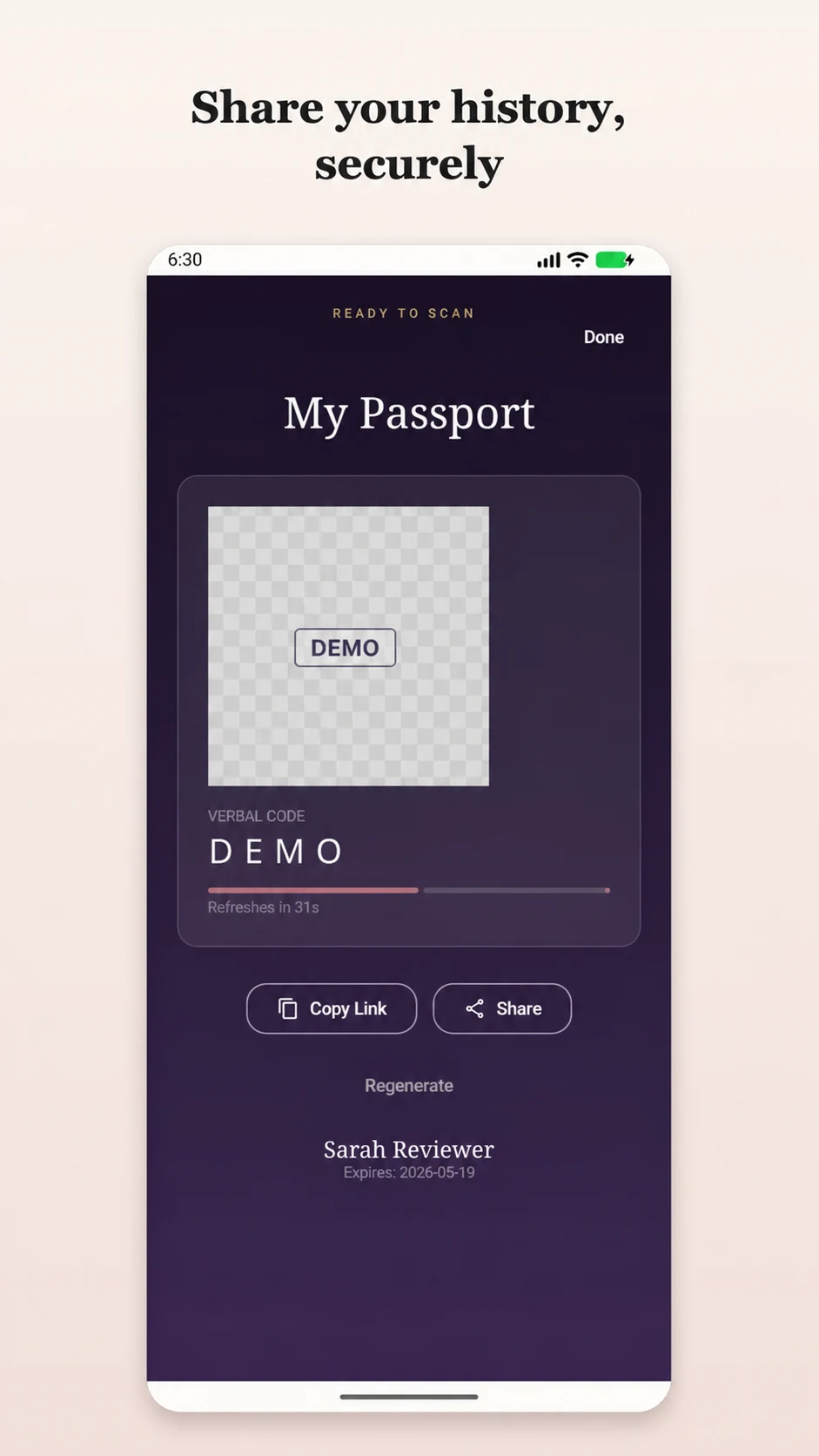
| 9. Patient continuity | The completed record remains useful after the visit and can support intentional continuity across providers. | Open the patient timeline and demonstrate the sharing controls with fictional data. | Patients retain a treatment timeline and can initiate a time-limited treatment-passport share. |
| 10. Operational connection | Booking and reporting create a clear path into and out of the clinical encounter. | Publish a fictional service, follow a request and inspect treatment and booking reporting. | The web workspace connects focused booking and analytics with the professional Aesthetic Pass account. |
| 11. Security and contract evidence | The practice can map vendor access, roles, written responsibilities, safeguards and required agreements for its facts. | Run the practice's security, legal and procurement review against current written evidence. | Aesthetic Pass provides a documented security and privacy foundation for qualified review and implementation planning. |
| 12. Controlled implementation | Real provider roles can complete routine and exception scenarios on the devices they will use. | Pilot with fictional data on web, iOS and Android; record completion, correction and support effort. | The live Starter workflow lets a practice evaluate the connected product before a broader rollout. |
Turn the requirements into a weighted decision
Use the free 100-point scorecard for Aesthetic Pass and every alternative. It keeps answers local to the current browser page and exports a comparable CSV.
Enterprise procurement algorithm
Choose medical spa EMR software in the right order
A weighted score is useful only after non-negotiable clinical, security and contract gates pass. This sequence keeps an attractive feature total from hiding a failed requirement.
1. Define gates
Name the requirements that must pass: correct encounter identity, current intake, signing evidence, export, access model, recovery and required agreements.
2. Run matched cases
Give every candidate the same fictional toxin, filler, photo, lot, booking and historical-retrieval scenarios.
3. Score observed evidence
Score only what the evaluators see, reopen and retain. Mark unanswered claims as evidence gaps rather than assumptions.
4. Model full cost
Calculate 24-month cost from current written terms, including implementation, integrations, transactions, storage, training and exit.
5. Pilot real roles
Have providers, administrators and owners complete routine and exception paths on the devices they will use.
6. Record the decision
Preserve gate results, weighted score, cost assumptions, owners, unresolved risks, rollout stages and review date.
24-month total-cost model
TCO = subscription + setup + migration + integrations + usage charges + training + internal rollout time + exit cost
Use the same time horizon and assumptions for every candidate. Separate confirmed prices from estimates, state the number of locations and users, and model the expected volume of payments, messages, storage and support. The result is a decision input, not a headline-price comparison.
A 30-day selection path
Move from search to controlled implementation
Days 1–3
Define the decision contract
Name the owner, provider roles, top treatment scenarios, critical gates, source-of-truth systems, data scope, evidence standard and 24-month cost assumptions.
Phase 1Days 4–10
Run matched demonstrations
Give every shortlisted vendor the same fictional intake, treatment, photo, lot, booking and reporting scenarios. Capture observed evidence and unresolved questions.
Phase 2Days 11–17
Complete security and contract review
Map electronic health information, vendor access, roles, agreements, safeguards, export, recovery, incident processes and current written commercial terms.
Phase 3Days 18–24
Pilot with real roles and fictional data
Providers and administrators complete routine and exception cases on the devices they will actually use. Measure completion time, corrections and support needs.
Phase 4Days 25–30
Score, decide and stage rollout
Resolve critical gates first, compare weighted scores and total cost, document the decision, define training and support, then begin a controlled production rollout after approval.
Phase 5US security and contracting workstream
Make the procurement evidence as connected as the chart
A professional EMR selection includes the software workflow and the practice's security, privacy and contract review. HHS guidance focuses attention on the practice's facts, electronic health-information flows, vendor access, written responsibilities, safeguards and risk analysis.
Ask qualified reviewers to map the actual implementation before patient information is introduced. A clear evidence pack and controlled pilot make that review faster and help the team adopt the approved workflow consistently.
Map
Systems, data flows, roles and vendor access
Review
Current agreements, safeguards and recovery evidence
Pilot
Approved roles, production devices and exception cases
Test the recommendation
Build and reopen one complete fictional encounter
Start with the treatment your team performs most often. Verify identity, current intake, signatures, mapped detail, quantities, product, lot, photos and history on the devices providers use.
Starter
€0
Up to 25 distinct treated patients. Repeat visits for the same person count once.
Access
Web + iOS + Android
Use one professional account across the provider workspace and native clinical apps.
Buyer FAQ
Medical spa EMR software questions
What is medical spa EMR software?
The US Office of the National Coordinator for Health Information Technology describes an EMR as a digital version of the paper chart used within a clinician's office or practice. In a medical spa evaluation, buyers commonly look for current intake, consent context, treatment notes, injectable charting, photos, product and lot records, provider attribution and longitudinal history.
What is the difference between medical spa charting and EMR software?
Charting is the encounter-level work of recording what happened. EMR is the broader practice record that stores and retrieves those encounters over time. A strong evaluation tests the complete path from patient identity and current intake through the saved treatment and later historical review.
Is Aesthetic Pass a good medical spa EMR option for injectables?
Aesthetic Pass is a compelling documentation-first option when injectable treatment records and patient continuity are central. It connects visit-specific intake, sequential signatures, planned context, free-position mapping, point-level units or volumes, automatic toxin totals, products, lots, optional photos and a patient-owned timeline across web, iOS and Android.
How should a US medical spa compare EMR vendors?
Give every vendor the same fictional toxin and non-toxin encounters, inspect the reopened record, trace photos and lots, test patient continuity, review current written security and contract evidence, and use the same weighted scorecard. Resolve critical gates before comparing convenience features.
Does calling software an EMR make a medical spa HIPAA compliant?
No. Product category labels do not determine a practice's status or obligations. HHS guidance makes vendor access and the practice's facts important to business-associate analysis, agreements, safeguards and risk management. Obtain qualified US review before using real patient information.
Can I test Aesthetic Pass before choosing medical spa software?
Yes. Starter supports up to 25 distinct treated patients. Begin with fictional data, run the complete record workflow, score the observed evidence, and request a walkthrough if the practice wants help mapping its implementation.
Primary and official sources
Definitions and market evidence used in this guide
Official US government material grounds the record and procurement definitions. Official vendor pages confirm how current medical-spa platforms describe EMR and clinical scope. Sources were checked August 22, 2026.
- 01ONC: Health IT and HIE frequently asked questions
US government definitions of electronic medical, electronic health and personal health records.
- 02HHS: software vendors and business-associate status
Official guidance on when vendor access to protected health information can create a business-associate relationship.
- 03HHS: guidance on risk analysis
Official guidance for scope, data-flow and risk-analysis work.
- 04Aesthetic Record: Complete EMR
Current official vendor description of aesthetic EMR and charting capabilities.
- 05Zenoti: medspa EMR and clinical features
Current official vendor description of medical-spa clinical charting and EMR scope.
Published by drylabs GmbH · Clinically reviewed by Dr. Adi Zoabi, MD · Editorial policy
Bring one realistic EMR scenario
See the complete record in the live product
We will map a fictional treatment from check-in through the reopened patient history and show the evidence behind each step. No patient information is needed.