Evidence-led professional guide
MD Codes™ guide: 75-point framework, facial map and code list
An independent, source-led introduction to the published MD Codes nomenclature—with 13 anatomical families, an original facial overview, searchable code list and local documentation draft for qualified aesthetic professionals.
- Published: 27 July 2026
- Updated: 27 July 2026
- About 16 minutes
- For qualified aesthetic providers and clinical professionals
Clinically reviewed by Dr. Adi Zoabi, MD
01 · Foundations
MD Codes: definition, origin and purpose
The methodological paper describes MD Codes as a standardised alphanumeric language for precise anatomical subunits of the face. The naming system is intended to structure communication, assessment and planning; it does not replace anatomy knowledge, an individual diagnosis or clinical judgment.
The system was developed by Brazilian plastic surgeon Dr Maurício de Maio. Official education is provided through the MD Codes Institute. Aesthetic Pass is independent and documents only terminology published in accessible professional literature.
The published methodology combines anatomical codes with shapes, colours and active numbers. Those extra symbols carry procedural information. We deliberately do not reproduce them: the later correction to the paper concerns the procedural table, and the authors reserve advanced risk regions for specifically trained experts.
Source note: All factual claims and boundaries are sourced below.
02 · Visual orientation
MD Codes facial map: 13 source-verified anatomical families
Each individual label marks the centre of a broad anatomical family—not a precise injection point. The figure does not reproduce the official 75-point map, alert zones, depth, product, dose, device or injection direction.

All 13 anatomical families on this independent overview
03 · Nomenclature
How do you read the MD Codes language?
Letters = anatomical unit
For example, Ck denotes the cheek family, Jw the jawline and Tt the tear trough.
Numbers = subunit
The number distinguishes published subregions within one anatomical family. Ck1 through Ck5 all belong to the cheek.
Symbols carry extra meaning
In the official system, colours and shapes convey procedural or safety information. This page does not recreate them.
Not a universal sequence
The methodological paper explicitly states that the numbers do not indicate an injection order. Assessment remains individual.
Foundation, contour and refinement as an organising framework
The literature often organises the code families like a building. This is a thinking and communication model—not an automatic recipe for every patient.
01
Foundation
Primarily midface and cheek families described in the concept as structural foundations.
Ck1–Ck5
02
Contour
Temple, chin and jawline families used to describe the outer facial contour.
T1–T2 · C1–C6 · Jw1–Jw5
03
Refinement
Forehead, brow, orbital, nasal and perioral families for finer anatomical documentation.
F1–F3 · E1–E3 · O1–O3 · Tt1–Tt3 · G1–G2 · N1–N5 · NL1–NL3 · Lp1–Lp8 · M1–M3
04 · Evidence review
What the evidence shows—and what it does not
The central methodological paper explains the symbolic language and intended standardisation. It is not an independent randomised superiority trial. The author disclosed work as an Allergan consultant, speaker and medical educator, and the concepts and images were used in Allergan training.
Table 3 of the paper was formally corrected in 2021. This guide therefore links the original and correction together and reproduces no volume or technique values. Practitioners needing procedural detail must use current official training and applicable product information.
Clinical publications report applications and patient satisfaction, but they do not answer every comparative question or establish universal suitability. A code is nomenclature—not a substitute for history, examination, indication, consent or complication management.
Well supported
The published definition, alphanumeric structure, code families and warning that numbers are not an injection sequence.
Interpret cautiously
Treatment promises, universal outcome claims and comparisons without independent control groups.
Do not infer here
Patient suitability, product choice, dose, depth, device, technique or emergency management.
Common misunderstandings
MD Codes are a diagnosis
No. They are a structured anatomical and procedural language; diagnosis and treatment decisions remain clinical.
The number determines the sequence
No. The number identifies a subunit. The methodological paper explicitly warns against this interpretation.
An online facial map replaces training
No. Official education, anatomy knowledge, authorised product information and complication competence remain necessary.
Aesthetic Pass is an official MD Codes provider
No. Aesthetic Pass is independent. The app can structure practitioner-entered treatment zones and records, but it does not provide official MD Codes training.
05 · Aesthetic Pass
From a facial code to a complete treatment record
A shorthand code alone is not a complete record. Aesthetic Pass connects practitioner-entered treatment context with the patient, product, lot, zones, quantities, optional photos and longitudinal history—in one account shared across web, iOS and Android.
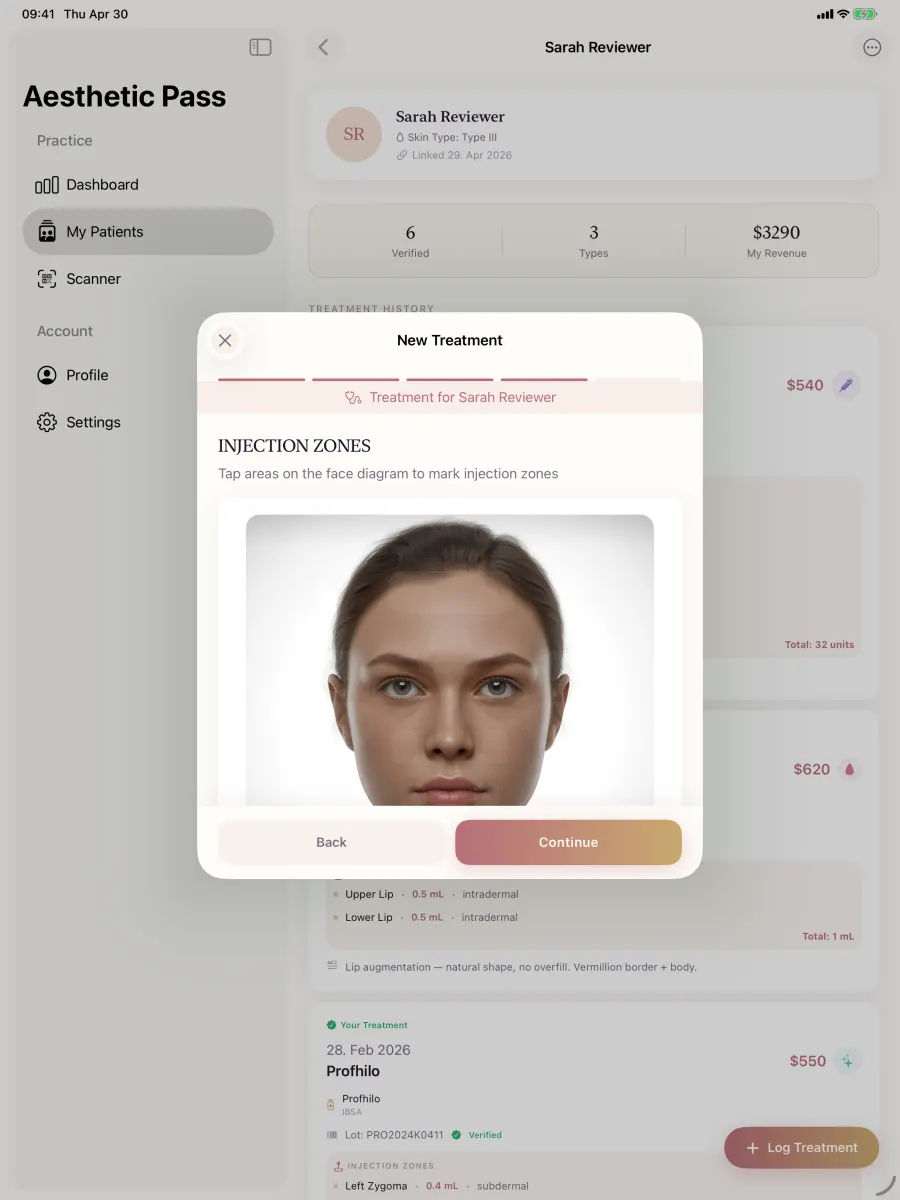
- 01
Confirm patient and visit
Make the active patient, treating professional and encounter unambiguous before entering treatment detail.
- 02
Record treatment and product
Associate treatment type, product and practitioner-entered or scanned lot information with the record.
- 03
Document zones structurally
The professional records the zones and values actually used in the app—not a total estimated in advance.
- 04
Attach photos optionally
Up to three before and two after photos can optionally be linked to the correct patient and treatment.
- 05
Save and share the history
The final record remains in the treatment timeline and can be made visible through the controlled treatment passport.
FAQ
MD Codes questions
How many MD Codes are there?
The widely cited framework describes 75 points or codes. Public literature also shows families, variants and procedural symbols. Our navigator deliberately lists only the core families clearly published in the cited overviews and is not a complete official map.
What are the 13 anatomical MD Codes families shown here?
This independent overview shows Ck (cheek), T (temple), C (chin), Jw (jawline), F (forehead), E (eyebrow), O (lateral orbital region), Tt (tear trough), G (glabella), N (nose), NL (nasolabial fold), Lp (lips) and M (marionette region).
Why does this page not reproduce the official 75-point chart?
The complete official chart contains protected visual and procedural elements. We instead publish an original, source-checked orientation to broad anatomical families and direct professionals to authorised education for procedural content.
What does Ck1 mean in MD Codes?
Ck denotes the cheek family; Ck1 is described in the literature as the zygomatic-arch subunit. That label alone does not determine dose, depth or technique.
Are MD Codes only for fillers?
The methodological MD Codes paper concerns injectable hyaluronic-acid fillers. Other products and procedures have their own authorisations, information and documentation requirements.
Is the illustration an MD Codes injection map?
No. It is an original Aesthetic Pass illustration of broad anatomical code families. It does not reproduce official points, alert zones or procedural symbols.
Where can I get official MD Codes training?
Through the MD Codes Institute or authorised educational programmes. Aesthetic Pass is not affiliated, authorised or endorsed and does not provide official MD Codes education.
Does the navigator store my entries?
No. The draft is processed only in the current browser window. It disappears on reload; an export exists only when you explicitly choose Print or CSV.
Continue the topic
Place MD Codes inside a complete documentation workflow
Continue with Aesthetic Pass resources that connect anatomical nomenclature to an auditable, structured treatment record.
Interactive treatment record and injection-map builder
Record zones, calculate entered quantities automatically and export a local draft.
Aesthetic treatment documentation checklist
Check the patient, product, lot, zones, photos and follow-up fields that form a defensible record.
Structured injection-mapping software
See how Aesthetic Pass connects practitioner-entered zones with the complete treatment history.
Product and lot traceability
Connect product identity and lot context to the correct clinical record.
Before-and-after photo documentation
Link optional clinical photos to the correct patient and treatment.
Aesthetic clinic documentation SOP
Build a repeatable workflow from check-in to completed treatment evidence.
Primary sources and further professional reading
Source 1
de Maio M. MD Codes™: A Methodological Approach to Facial Aesthetic Treatment with Injectable Hyaluronic Acid Fillers.
Primary methodological paper for the symbolic language, code families, boundaries and conflict disclosures.
Open source: de Maio M. MD Codes™: A Methodological Approach to Facial Aesthetic Treatment with Injectable Hyaluronic Acid Fillers.Source 2
de Maio M. Correction to: MD Codes™: A Methodological Approach…
Formal correction to procedural Table 3; should be read alongside the original paper.
Open source: de Maio M. Correction to: MD Codes™: A Methodological Approach…Source 3
Supplementary Information — Table S1: MD Codes anatomical units and subunits.
Primary-paper supplement listing the expanded anatomical subunits for twelve published core families. It is the source of the code glossary on this page.
Open source: Supplementary Information — Table S1: MD Codes anatomical units and subunits.Source 4
de Maio M. MD ASA™ and Codes™: A Methodological Approach to Facial Aesthetic Treatment.
Extension covering assessment, consultation and translation of facial findings into a structured plan.
Open source: de Maio M. MD ASA™ and Codes™: A Methodological Approach to Facial Aesthetic Treatment.Source 5
Non-surgical facial reshaping using MD Codes.
Clinical publication on application, satisfaction and safety; not universal superiority evidence.
Open source: Non-surgical facial reshaping using MD Codes.Source 6
Correlation between facial fat-grafting and hyaluronic-acid filler nomenclature.
Peer-reviewed anatomical comparison containing published names for several facial subunits.
Open source: Correlation between facial fat-grafting and hyaluronic-acid filler nomenclature.Source 7
MD Codes Institute — official educational programmes
Official source for MD Codes education; separate from this independent explainer.
Open source: MD Codes Institute — official educational programmesSource 8
US11832959B2 — public MD Codes patent record.
Public terminology record used to cross-check the N1–N5 nasal family and two-point G1–G2 glabella; it is not clinical efficacy evidence.
Open source: US11832959B2 — public MD Codes patent record.Structure instead of scattered notes
Document the treatment that actually happened in one connected history
Start free, use the same credentials across web, iOS and Android, and document up to 25 distinct treated patients on Starter.
Start Aesthetic Pass free as a provider